


The Lighthouse of Alexandria: Evidence from Ancient Texts
Laura Aguer
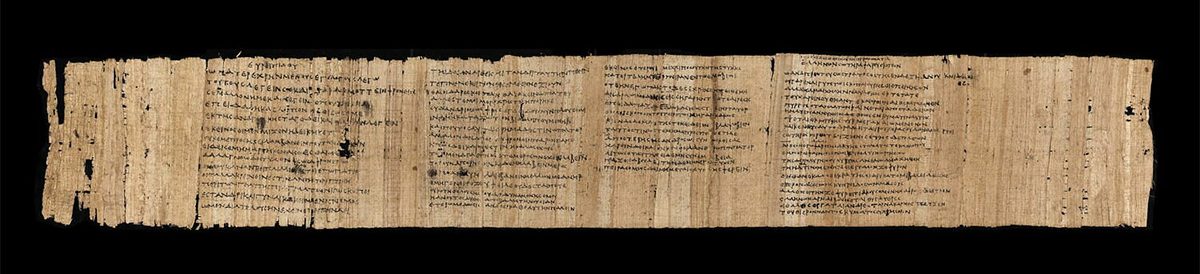
Epigram on the Pharos of Alexandria by Posidippus of Pella, preserved on Papyrus Louvre E 7172 (Didot Papyrus)
The Lighthouse of Alexandria appears in texts throughout Antiquity. Authors, both Greek and Latin, mention the monument and do not fail to heap superlatives in describing it. For Lucian of Samosata, it is “the greatest and most beautiful of all works of architecture” (μέγιστον καὶ κάλλιστον ἔργων ἁπάντων, How to Write History, 62). According to Achilles Tatius, “erected like a mountain in the middle of the sea, it touched the clouds” (ὄρος ἦν ἐν μέσῃ τῇ θαλάσσῃ κείμενον, ψαῦον αὐτῶν τῶν νεφῶν, Leucippe and Clitophon, V.6). Thus, the lighthouse is indeed a marvel: it astonishes and arouses admiration in those who see it. However, no precise description of the lighthouse dating from antiquity has survived to us. The historian must then comb through the texts in search of rare indications about its structure and clues to retrace the monument’s history.
A Tower on Pharos Island
In Greek and Latin texts, the Lighthouse is designated by the word “tower” (πύργος, turris). This tower was built on an island called Pharos, which becomes a peninsula when it is connected to the mainland by a causeway named Heptastade, probably around the same period as the lighthouse’s construction. The toponym Pharos already appears in Homer, in the Odyssey (IV, 354–355). The Greek king Menelaus is detained there on his return from Troy. In writings from the 1st century BCE, the tower already bears the name “Pharos,” which it derives from the island on which it stands (Caesar, Civil War, III.112). The common noun pharos, designating a tower that guides sailors, will not appear in Greek until the 1st century CE.
The danger of the Alexandrian coast is repeatedly emphasized by the Ancients. Strabo (c.63 BCE – 23 CE), in his description of the coast (Geography, XVII.1.6), notes that it is strewn with shoals on which ships run the risk of wrecking. Following Strabo, Flavius Josephus (37 BCE – c.100 CE) also describes these shoals and the narrowness of the passage by which mariners entered the great port of Alexandria, which posed another obstacle for boats (The Jewish War, IV.10.5). The construction of a tower to guide ships therefore proved essential at the time of Alexandria’s founding.
A first mention in Greek poetry: Posidippus’ epigram
This article on the word “pharos” in the Suda, a Greek lexicon from the 10th century CE, provides us with the date for the start of the works. Construction began in 297 BCE under Ptolemy I, to be completed in the early reign of Ptolemy II. According to Pliny the Elder, its construction would have cost 800 talents (Natural History, XXXVI.18). The lighthouse first appears in texts under Posidippus of Pella (c. 310–240 BCE), who practiced his art at the court of Ptolemy II. Epigram 115 by Posidippus has been transmitted to us by a papyrus, Louvre Papyrus 7172 (also called Papyrus Didot), on which one of the priests of the Serapeum of Memphis copied it, among other poetic works, during the reign of Ptolemy VI (c.160 BCE). The poem begins with an invocation to Proteus, the marine deity, master of the island of Pharos. If the lighthouse is indeed at the center of the work, the true subject of the epigram is not the tower itself and “the great fire burning at its summit” (ἐκ κορυφῆς πῦρ μέγα καιόμενον), but a certain “watcher of Pharos” (Φάρου σκοπός), “savior of the Greeks” (Ἑλλήνων σωτήρ), whose name is revealed by the poet only at the end of the text: Zeus Saviour (Ζεύς Σωτήρ). Indeed, at Posidippus’s time, perhaps a statue of Zeus Saviour stood at the top of the monument. It will be necessary to wait until the end of the Hellenistic period and the beginning of the Roman era to have new mentions of the lighthouse, in Caesar, Strabo and Diodorus of Sicily.
An Architect as Mysterious as His Work
In his epigram, Posidippus provides another important element: the name of Sostratus of Knidos. Sostratus was long regarded as the architect of the Pharos. Pliny the Elder, in the 1st century CE, designates him as architectus (Natural History, XXXVI.18). Lucian of Samosata (c.120–180 CE), in How to Write History, 62, uses the same title (architektōn) for “a certain architect of Knidos” who built (οἰκοδομέω) the Pharos tower. However, it is more plausible that Sostratus financed its construction. Strabo (Geography, XVII.1.6) indeed mentions Sostratus of Knidos, accompanied by his royal-friendly title “friend of kings” (φίλος τῶν βασιλέων), who “dedicated” (ἀνέθηκε) the monument. This event is commemorated by an inscription (ἡ ἐπιγραφή) on the monument, also noted by Pliny the Elder (Natural History, XXXVI.18). Regarding this inscription, Lucian of Samosata relates an anecdote illustrating Sostratus’s ingenuity: he supposedly inscribed on the monument a dedication to the Gods Saviors (Ptolemy I and his wife Berenice, deified after their deaths, whose epithet recalls Zeus Soter in Posidippus’s epigram) bearing his own name, then covered the inscription with plaster to place the king’s name. A few years later, the plaster fell away, revealing the architect’s name in place of the king’s.
A fire that guides ships
Pliny the Elder, in Natural History (5.34; 36.18), does not omit mention of the Pharos; he notes the flame burning at its summit, which mariners might mistake for a star (sidus). Achille Tatius (2nd–3rd CE), in Leucippe and Clitophon, V.6, compares the Pharos’s fire to the sun (ἥλιος), a “guide of ships” (τῶν νεῶν κυβερνήτης). Flavius Josephus (37 CE–c.100 CE) adds that the fire is visible at 300 stades, i.e., about 55 km (The Jewish War, IV.10.5). Thus, the Latin poet Lucan (39–65 CE), in Pharsalia IX, v. 1006, uses the phrase “a lamp in the night” (nocturnam lampada), an oxymoron that evokes this famous flame. According to Pliny (Natural History, XXXVI.18), the fire burned continuously (continuatio ignium). Yet he also mentions in the same work (5.34) fires lit at night (e turri nocturnis ignibus cursum navium regens). No author specifies how the fuel was conveyed to the summit to sustain such a blaze.
The Lighthouse and the Travelers
The Pharos has fascinated many travelers passing through Alexandria. This fascination is evident in texts such as Diodorus Siculus’s Library of History (Book XXXIII, 22). He describes a visit by a delegation from Rome to Egypt around 140/139 BCE, under Ptolemy VIII, commanded by Scipio Aemilianus. The Romans, symbols of virtue (ἀρετή) against the East’s splendors, disregard the riches the Egyptian king presents. Yet they also examine “the importance and the peculiarities of the Pharos” (καὶ τὸ βάρος καὶ τὰς περὶ τὸν Φάρον ἰδιότητας) with great interest, likely curious about the technical know-how behind its construction and the works there.
In 47 BCE, during the civil war between Cleopatra VII and her brother Ptolemy XIII, Alexandria became the theater of the fighting. Julius Caesar, who was defending the queen’s interests, found himself in a precarious position on the island of Pharos. In his account of the war (Civil War, III.111–112), Caesar mentions Pharus, the “tower of great height” (turris magna altitudine) that rises on the island. The Pharos is a “marvelous construction” (mirificis operibus exstructae), but the author provides no further details and rather dwells on the hostility of the island’s inhabitants. On his return to Rome, for his triumph over Egypt, Caesar stages a representation of the Pharos of Alexandria (Florus, Epitome II.13), a characteristic monument that allowed spectators to identify the defeated at a glance.
Another Roman visiting Alexandria gave a precise description of the Greco-Egyptian city’s topography. This is Strabo, author of Geography, whose work includes a section on Egypt, which he visited in 25–24 BCE. In Book XVII.1.6, after describing the Pharos peninsula and the surrounding reefs, Strabo turns to the Pharos itself, the “Tower of the Pharos” (πύργος τῆς Φάρου) that dominates the great port of Alexandria. It is a multistoried tower (πολυώροφος), built of “white stone” (λευκοῦ λίθου). Strabo conveys the sense of awe at the monument through the adverb θαυμαστῶς (“astonishingly,” “admirably”). This remains the most detailed description of the Pharos in ancient texts.
The Pharos: A Model for Maritime Architecture
The Pharos of Alexandria served as a model for other lighthouses in the ancient world. In their writings, the Ancients notably refer to the Pharos of Ostia, the port of Rome. Suetonius (c. 70–140 CE), in Life of Claudius, 20, reports that the emperor had “a very tall tower (altissima turris) built there on the model of the Lighthouse of Alexandria (in exemplum Alexandrini Phari)”. Pliny the Elder (Natural History, XXXVI.18) writes that several lights similar to the Pharos of Alexandria existed in his time, for example at Ostia and Ravenna. Finally, Strabo compares the Tower of Caepio, in Spain, to the Egyptian monument (Geography, III.1.9). Its fame was such that the Pharos of Alexandria inspired for centuries the architects of the Hellenistic and Roman worlds.
Le CEAlex vous propose de citer cette page de la manière suivante :
Laura Aguer, « Le phare d’Alexandrie : le témoignage des textes anciens », Projet Pharos du CEAlex, consulté le 6 October 2026 à l’adresse
https://pharos.cealex.org/ressources-documentaires/textes/sources-antiques/