


The Lighthouse of Alexandria on non-monetary objects
Eléni Fragaki
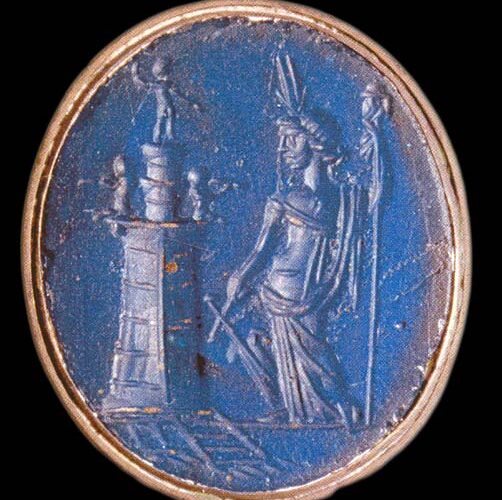
Intaille de verre bleu (Kunsthistorisches Museum, Vienne – inv. AS XI a 991 – provenance inconnue, datée du 2e s. de n. è.) – A côté du Phare d’Alexandrie est représentée Isis Pharia
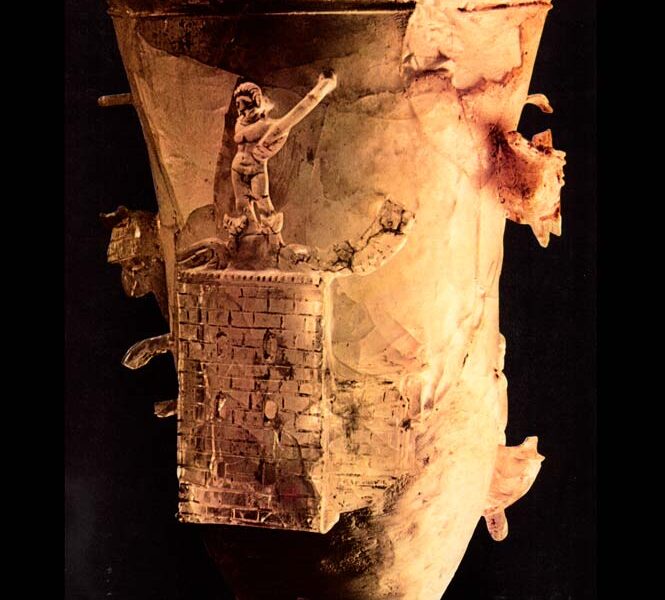
Le Phare d’Alexandrie sur le gobelet en verre trouvé à Begram, à côté de Kaboul (Musée de Kaboul, inv. 57.291, provenance probable Alexandrie, daté de la fin du Ier, début du IIe s. de n. è.)
The Lighthouse of Alexandria appears on artworks or ancient objects other than coins: mosaics, glass, terracotta, gems and intaglios, tesserae, the Peutinger Table, etc. Some representations are already recognized as such and covered in modern bibliography; but it is necessary to seek out others, rare or unknown, which have not yet been examined, to complete the corpus.
Discussions and research in Alexandria
This work thus completes the database on the iconography of the Lighthouse and makes it possible to highlight aspects of the building and its context. It was an opportunity to consult rare and old publications, difficult to find elsewhere, which have probably not been frequently utilized. Thus, in a report of the Greco-Roman Museum for the year 1922-23, published in 1924, there are two small fragments that have never been studied and which, according to E. Breccia, who wrote this text, might evoke the Lighthouse of Alexandria. The first object is in brick-red clay. It reportedly preserves the part corresponding to the upper end of the third floor, built in isodomic ashlar masonry and surmounted by fuel and flames. On the second, a painted plaster discovered in Hadra (inv. no. 21.158), we see a cylindrical tower drawn in light red that opens at the top to let the fire emerge. The first fragment was quickly spotted in the registers thanks to the number indicated by E. Breccia; requests for study authorization are currently underway. The other, however, for which no more precise information is available, has not yet been located. Regardless of the validity of the identification proposed by this author, it would be advisable to examine the two objects more closely by comparing them to the already established representations of the monument.
The director of the Greco-Roman Museum also pointed out that there is a rich series of terracotta lamps in the collections that reproduce the Lighthouse in miniature. Since only two of them appear in the bibliography, the rest of this material, completely unpublished, will deserve special attention.
Exploration of online resources and library studies
The utilization of online resources now offers a whole series of unpublished objects that must be exploited. Indeed, Héloïse Aumaître had spotted in the digital catalog of the National Library of France (BnF) a red jasper intaglio belonging to the H. Seyrig collection, which represents the Lighthouse of Alexandria. On this small piece with a maximum diameter of 11 mm, examined on site, one can distinguish the tower with its characteristic structure, its access ramp, and its sculpted decoration (two tritons and a summit figure), as well as two arches of a bridge and the prow of a ship sailing in the background. In the same institution, there is, in the glyptic archives of H. Seyrig, a photo of a similar impression, where one sees, next to the building, the entire sailboat navigating the waves and, in the foreground, a three-arched bridge, probably corresponding to the one that connected the eastern tip of the island of Pharos to the islet on which the monument was located.
Two other gem impressions showing the Lighthouse also exist in the Cornell University collection. On one of them, the building, which once again features its distinctive architectural and sculptural traits, appears isolated, surrounded by signs and symbols. On the other, however, it is situated in a true urban landscape populated by small figures, but also featuring a columned facade and pediment and a second arched bridge preceded by rocks, visible in the background. The sailboat, still present, faces a head of Sarapis in profile. Both objects are absent from the bibliography, but the second finds a very close parallel in an impression from the Cades collection, analyzed in an article by M. Pensa1.
An object-by-object bibliography, as exhaustive as possible, was used to extract the necessary information to complete the database: dating (sometimes controversial), material and manufacturing technique, history of discovery, location and state of conservation, and description of the images. This makes it possible to identify the structural characteristics of the tower (number and morphology of the floors and windows, shape of the door and the ramp), the rendering of the sculpted decoration (posture, attributes, and proposed interpretations for the summit statue, number and gestures of the Tritons), as well as ancillary figures (Isis, ship). This partly unpublished documentation provides solid support for the study of the reconstruction of the lighthouse.
1 M. Pensa, « Moli, fari e pescatori : la tradizione iconografica della citta portuale in eta romana », Rivista di Archeologia 23, 1999, p. 99, 105-106, 119.
Le CEAlex vous propose de citer cette page de la manière suivante :
Eléni Fragaki, «Projet « Pharos » – iconographie, représentations autres que monétaires », Projet Pharos du CEAlex, consulté le 6 October 2026 à l’adresse
https://pharos.cealex.org/ressources-documentaires/les-images/autres-que-monnaies/