


The Lighthouse of Alexandria
Isabelle Hairy
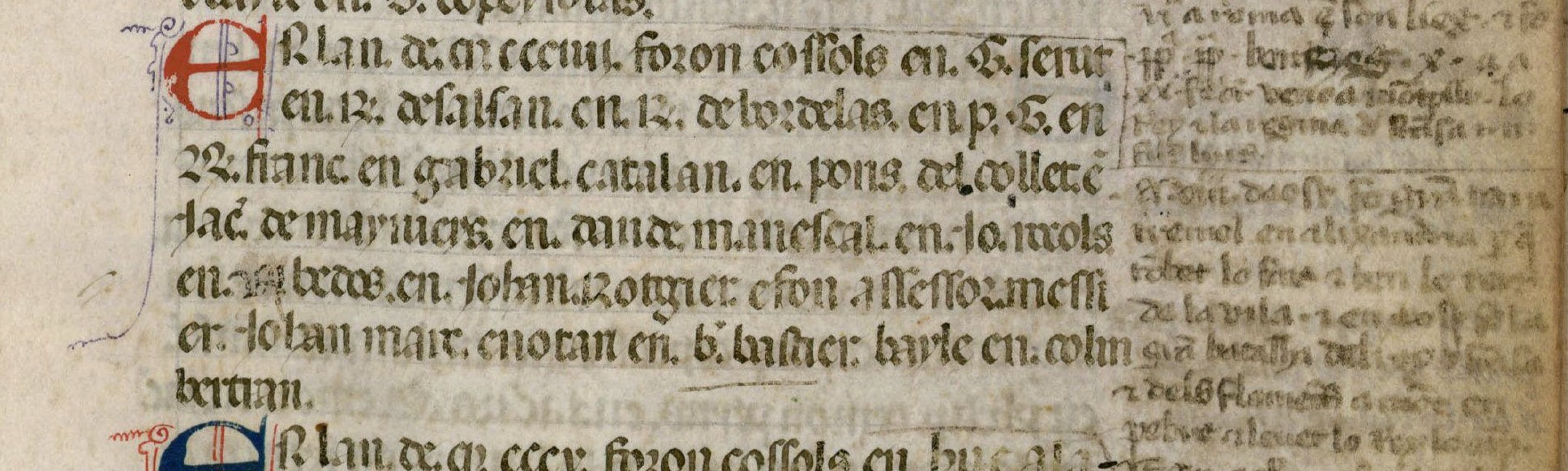
“On the 8th of August, there was a great earthquake in Alexandria, causing the lighthouse to fall and nearly a third of the city as well.”— Consular Annals of 1304. Marginal note mentioning the earthquake and the collapse of the Lighthouse of Alexandria. AdM, AA 9, Petit Thalamus, fol. 83.
“On the 8th of August, there was a great earthquake in Alexandria, causing the lighthouse to fall and nearly a third of the city as well.”— Consular Annals of 1304. Marginal note mentioning the earthquake and the collapse of the Lighthouse of Alexandria. AdM, AA 9, Petit Thalamus, fol. 83.
The Lighthouse of Alexandria was built in record time. It took only about fifteen years to erect this fabulous tower facing the sea, at the entrance of the harbor, signaling the presence of Alexandria from afar on a coast lined with shoals and reefs. It controlled the entrances to the Great Port, long known as the “Lighthouse Port,” as reported by several ancient authors. Construction began in 297 BCE, according to a late text, the Souda, a 10th-century Greek lexicon. Ptolemy I initiated the project but did not live to see its completion. The Lighthouse was finished under Ptolemy II, during the 124th Olympiad (between 283 and 281 BCE), according to the chronology of Eusebius, compiled in the 4th century CE.
The Roman historian Pliny the Elder (1st century CE) reported that the construction cost 800 talents, equivalent to about 17 tons of silver, with a Ptolemaic talent weighing 21.4 kg. For comparison, the Parthenon, built a century and a half earlier, cost only 469 talents—just over 12 tons of silver—based on the legal talent of 25.92 kg (Solon’s reform).
Many ancient authors spoke of the Lighthouse with admiration, including the Greek geographer and historian Strabo, who visited Egypt around 25–20 BCE. Earlier, Diodorus Siculus, who traveled to Alexandria in 60/59 BCE during the Greek monarchy of the Lagids, gathered material for his Historical Library. He noted that during the reign of Ptolemy VIII (mid-2nd century BCE), Scipio Aemilianus, leading a Roman delegation, visited Alexandria and requested to see the Lighthouse. He marveled at its significance and unique features, likely due to the advanced techniques used in its construction, which remained impressive a century and a half after its completion. Its fame endured throughout antiquity and the Middle Ages, with its image exported on various media (see documentary sources).
What do we know today about the Lighthouse, its design, and the technical features that amazed the Romans, who built their civilization on cutting-edge engineering? What did the Lighthouse look like?
For the Ptolemaic period, a few precious artifacts remain: a terracotta lantern from the Fayoum and the Lighthouse of Taposiris Magna. Standing about thirty meters tall, the latter is considered a smaller-scale replica, with its first square section, second octagonal section, and third circular section. The terracotta lantern also reproduces the three sections, with large block patterns on the walls.
Coins depicting the Lighthouse, from the reign of Domitian to that of Commodus, provide the most important documentary evidence. They show that the Lighthouse consisted of three sections topped by a statue—a distinctive silhouette found on most Roman representations, setting it apart from other Mediterranean lighthouses. The tower was built on a solid base, with a wide overhanging cornice crowning the first section. A large door, accessed by a stepped ramp built on arches, opened at its base. Windows punctuated the facades of this section, and four tritons were placed at the corners of the first terrace. Some coins also show, through two rows of dots, the presence of an inscription on the facade adjacent to the door, as later described by a 12th-century Arab-Andalusian traveler.
Tradition places a fire at the top of the tower, but it is difficult to imagine it sharing this space with the large statue depicted in many ancient documents. Its exact position remains debated. One might also wonder if it is related to the mirror that Arab tradition places at the summit of the Lighthouse.
After the conquest of Alexandria by Amr Ibn al-‘As in 641, many Muslim travelers en route to Mecca visited Alexandria. Some left precise descriptions of the Lighthouse, such as Ibn el Shayr of Malaga (12th century), Abu Hamid al-Gharnati (12th century), Yaqut al-Rumi (13th century), and others (see documentary sources). These accounts help refine the description of the Lighthouse, detailing its structure and both external and internal elements. For example, they specify the length of the access ramp to the door and the number of arches it included. They also describe the first section of the tower as built with dressed stone and containing multiple floors, accessed via a ramp. The second section, made of bricks and plaster in the Middle Ages, featured a staircase leading to the upper terrace. The final section consisted of two parts: the first, circular, enclosed a staircase leading to a small terrace covered by a wooden dome built by Ahmed Ibn Touloun. This dome was rebuilt several times due to its fragility—first by the Fatimid vizier al-Salih Tala’ib Ruzayq, then by the Ayyubid sultan al-Malik al-Kamil, and finally by Sultan Baybars. This lightweight structure was the highest mosque in the Muslim world and also served as an observatory, with its four doors oriented toward the cardinal points, confirming the Lighthouse’s semaphore function in the medieval period.
The consular annals of 1304 mention in a marginal note the tsunami of August 8, 1303 (AdM, AA 9, Petit Thalamus, fol. 83), which led to the “collapse of the Lighthouse of Alexandria.” The event was significant for the city, which had maintained commercial relations with Alexandria since the second half of the 12th century. Maqrizi reported that the earthquake completely destroyed the Lighthouse. However, according to Ibn Taghribirdi, princes began its restoration in 1304, and that same year, Emir Baybars al-Dawādār ordered its reconstruction. Yet, these efforts never materialized, and the Lighthouse was definitively abandoned. It served as a quarry for a time before disappearing beneath the waters of the Mediterranean.

Le Lighthouse of Taposiris Magna (2nd century BCE), located about forty kilometers west of Alexandria.
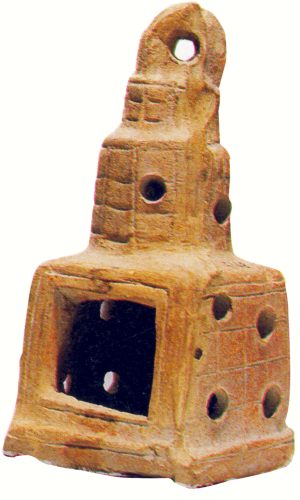
Terracotta lantern (Fayum, 2nd century BCE) (inv. MGR 8417)
CEAlex suggests citing this page as follows:
Isabelle Hairy, « “The Lighthouse of Alexandria,” CEAlex Pharos Project, accessed 6 October 2026, at
https://pharos.cealex.org/the-pharos-project/