


The Lighthouse of Alexandria in medieval Arabic texts
Oueded Sennoune
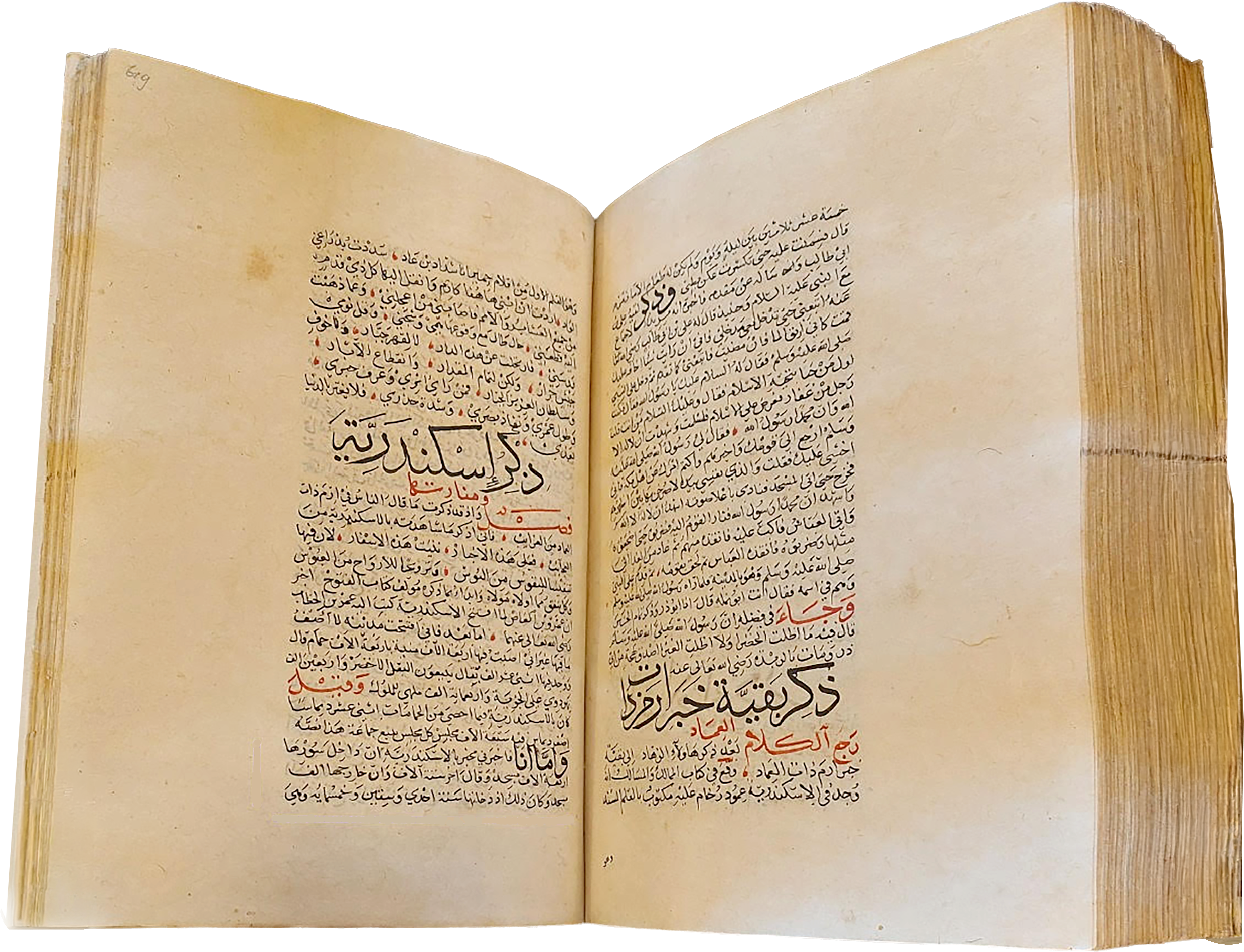
This presentation of the Lighthouse of Alexandria will focus solely on sources from Oriental languages. The descriptive approach to this monument adheres to criteria specific to this cultural context, where Arabic is the dominant language. In this literary production, the lighthouse is designated by the Arabic words “al- manār” or “al-manāra”, which literally means “the place of the fire.” While some authors position themselves as eyewitnesses, demonstrating authenticity, others are drawn into the genre known as “marvels,” which reflects an ancient, bygone and idealized world. Beyond the terms of fascination used to describe the lighthouse, the authors also provide information on its dimensions, general appearance, interior layout, access, condition, and various restorations. This overview will will be based on reliable texts, the earliest of which were written from the 9th century onward. During this period, which extends to the 15th century, several historical phases can be identified.
Geographers and historians of the Middle East
In the first phase, from the 9th to the mid-11th century, the authors were predominantly from Persia and Mesopotamia. The earliest writings on the lighthouse were produced by historianss and geographers, most often polygraphs, who had traveled, but without necessarily having visited all the regions they described in their works. The interest shown in this literary genre during the early centuries of Islam stemmed from a desire to understand and control the territory. Among these authors, we can mention Ibn H̱urdād̲bih (849-885; Kitāb al‑masālik wa al–mamālik), Ya‘qūbī (circa 889; Kitāb al-Buldān), Ibn Ḥawqal (late 10th century; Ṣūrat al‑Arḍ), and others. But in this initial phase, the book by the Baghdad-born Al-Mas‘ūdī (written before 956), entitled Kitāb al-tanbīh wa al-išrāf, stands out in particular. In this work, the historian presents a text whose structure served as a model for later authors considered reliable in terms of the information they provided about the lighthouse. Al-Mas‘ūdī begins by specifying the identity of the lighthouse’s builder, then goes on to mention its function, dimensions, condition, structure, restoration, inscription, and geographical location, concluding with a precise account of the earthquake. Of this first historical period, his text is undoubtedly the most complete and relevant.
Andalusian and Maghrebi pilgrims
During this second phase, spanning the second half of the 11th century to the 12th century, the works come primarily from travelers undertaking the pilgrimage to Mecca, but also from a polygraph, Al-Bakrī (written in 1067), author of the Kitāb al‑masālik wa al-mamālik. In this book, he presents a table of the routes and kingdoms, the title of which echoes that of Ibn H̱urdād̲bih, mentionned above. Like Al-Mas‘ūdī (see above), he develops a clear and fluid discourse that provides the information necessary for understanding this building and its surroundings. He gives details about the structure of the building, specifying its dimensions, its interior layout (ramp and openings), its condition, its location, its access, its role, and its function. The elements of this description offer a comprehensive view based on observations made on site. Although this author likely never visited Alexandria, he managed to gather valuable information about the lighthouse. Al-Bakrī’s work (written in 1067) marks a turning point in Andalusian literature, the influence of which can be seen, among other things, in the intellectual development of travel writers. The travel narratives of Andalusian pilgrims are imbued with the same keen sense of observation. Among the authors of this new literary genre called Riḥla, we can mention Abū Ḥāmid al Ġarnāṭī (travels in 1117 and 1121), Ibn Ǧubayr (travels in 1183) and, in particular, Yūsuf b. al- Šayẖ (Ibn al Shaykh), a philologist from Malaga who spent several months in Alexandria between 1165 and 1166. This eyewitness account is distinguished by his travel narrative, which is unanimously considered the most precise and complete of all the available records. During his ascent to the top of the lighthouse, he measured every corner of the structure, level by level, using a measuring cord, a sheet of paper, and a reed pen. His text remains unique for the entire medieval period and even more so for the lighthouse itself.
During the 13th and 14 th centuries, the genre of the Riḥla, which appeared in the previous century, continued to provide literary productions that were not insignificant, as evidenced by those of Abū Muḥammad al-‘Abdarī (travels en 1289), H̱ālid b. ‘Isā al-Balawī (1313-1378) and Ibn Baṭṭūṭa (travels in 1325 and 1349). Like Ibn Ǧubayr’s Riḥla (travels in 1183), these three literary works, written in a highly refined style, provide information drawn from their authors’ own observations. The first, Al-‘Abdarī, describes his ascent, which required great effort from him. He continues his narrative by mentioning its geographical location, its building materials, its structure, its access, its interior layout, and its access to the top level, which houses a mosque. He concludes his description by mentioning the strip of land that connects the lighthouse to the mainland. This Moroccan traveler’s text inspired that of his compatriot Ibn Baṭṭūṭa, though he is less verbose. The only elements that differ concern the state of the lighthouse, about which Ibn Baṭṭūṭa writes that in 1349, the building “was in such bad condition that it was impossible to access the door and enter it. Al-Malik an-Nâsir – may God have mercy on him! – had undertaken to build a lighthouse similar to the first one, opposite him, but death prevented him from completing it[1].”
The Encyclopedists
During the third phase, spanning the 13th to the 14th centuries, pilgrims’ travel narratives continued to be published, but a new genre emerged: the encyclopedia. Authors of diverse origins referred to their predecessors while also offering their own analyses. Yāqūt al-Rūmī, an author of Byzantine origin who became a slave in Baghdad at the age of five, wrote a work, between 1218 and 1224, entitled Mū΄gam al‑Būldan. Regarding the Lighthouse of Alexandria, this author rejects the idea of repeating what he considers fanciful stories. He questions facts that seem strange to him and dares to doubt certain texts. So much so that he prefers to base his account on what he himself witnessed during his visit to the lighthouse in the company of other scholars. Based on his own observations, he describes the shape of the building, the restoration of the foundation, its condition and appearance, its geographical location, its access, and its interior. As an eyewitness, he follows the same method as Al-Mas‘ūdī (before 956) and Al‑Bakrī (1067). The Persian geographer Zakarīyyā’ al-Qazwīnī (1275), author of the encyclopedia Aṯār al-bilād, followed the same path as his predecessor Yāqūt al-Rūmī. He described the lighthouse’s shape, its dimensions, its geographical location, its access, and its internal circulation. It is worth noting that in the works of both Yāqūt al-Rūmī and Zakarīyyā’ al-Qazwīnī, their texts are accompanied by sketches of the lighthouse to support their observations.
During this period, Egyptian authors, who had been almost entirely absent from this corpus until then, began to produce works in the form of encyclopedias. This was the case with Šihāb al Nuwayrī (1279-1332), born in Akhmim – not to be confused with the historian al Nuwayrī (14th century), author of the Kitāb al-Ilmām. His role as a scribe (kātib) in the service of the sultans enabled him to compile the knowledge necessary for this profession in his encyclopedia entitled Nihāyat al-arab fī funūn al-adāb. The second encyclopedist, Ibn Faḍl Allāh al-‘Umarī (written before 1349), originally from Damascus, was also part of the Mamluk chancery. At an unknown date, he wrote a work entitled Masālik al-abṣar fī mamālik al amṣār. These two authors dwell at length on the history, or legend, of the mirror that stood atop the lighthouse. But the Damascene author provides crucial information about the lighthouse’s final days: “I have been told that the Lighthouse of Alexandria is now in ruins; the stones have fallen and the monument has disappeared. Less than twenty cubits of the lighthouse remain. Although the Sultan has ordered its reconstruction, no attention is being paid to it[2].”
The accounts of Al-‘Umarī and Ibn Baṭṭūṭa, dating from the middle of the 14th century, mark the end of the lighthouse’s active presence. In the following century, two Egyptian authors reported important facts about this monument before its final collapse and beyond. In his work entitled H̱iṭaṭ, the historian Al-Maqrīzī (1363/4-1442) uses data from texts and archaeology to describe Egypt. Regarding the lighthouse, we learn that in 1274, Sultan Baybars (1223-1277) restored one of the corners of the structure which had fallen and that he reinstalled the dome of the mosque. Subsequently, during the earthquake of 1303, this mosque was destroyed in turn[3]. The second author, Ibn Iyās al-Ḥanafī (1448-1524), also a historian, wrote a book entitled Badāʾiʿ al-zuhūr fī waqāʾiʿ al-duhūr, in which he gives an overview of the entire history of Egypt up to the Mamluk period. He writes that in 1477, Sultan Ashraf Qaitbay “wanted to see the site of the ancient Lighthouse and ordered a tower to be built on the old foundations, and it was there that the mighty Donjon which still exists was built[4].”
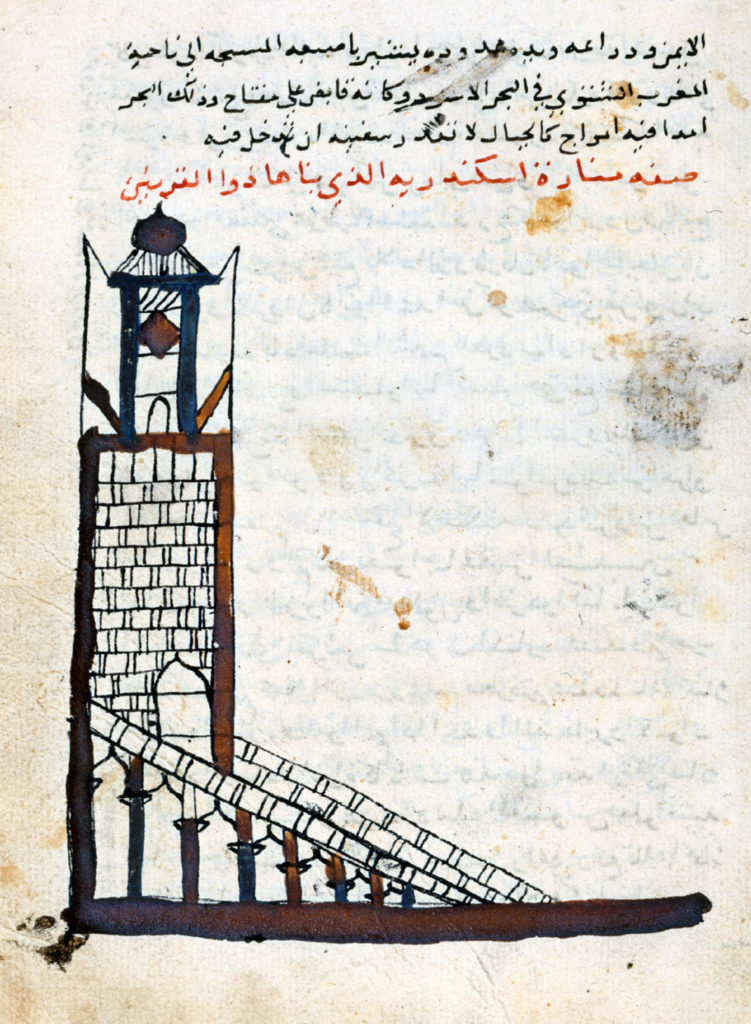
Phare d’Alexandrie illustrant la description de Abu Hamid Al-Gharnati dans un manuscrit du XVIe siècle (تحفة الالباب و نخبة الاعجاب « Cadeau offert aux hommes intelligents et choix de merveilles », par Moḥammad ibn ʿAbd al-Raḥîm al-Qaïsî, de Grenade ; BNF ; Ms arabe 2168). Il rédigea sa relation de voyage Al-Mu‘rib ʿan baʿḍ ʿajāʼib al-Maġrib en 1160, alors qu’il se trouvait à Bagdad, pour le vizir Ibn Hubayra (1105-1165).
[1] Ibn Faḍlān, Ibn Ǧubayr, Ibn Baṭṭūṭa et al., Voyageurs arabes. Ibn Faḍlān, Ibn Jubayr, Ibn Baṭṭūṭa et un auteur anonyme, éd. P. Charles-Dominique, Paris, 1995, p. 388.
[2] Ibn Faḍl Allāh al-‘Umarī, Masālik al-abṣar fī mamālik al-amṣār. L’Égypte, la Syrie, le Higaz et le Yemen, par A. F. Sayyid, Ifao, Le Caire, 1985, p. 93.
[3] Al- Maqrīzī, Description topographique et historique de l’Égypte (H̱iṭaṭ), par U. Bouriant, Mémoires de la Mission archéologique française au Caire XVII, 1900, p. 448.
[4] Ibn Iyās, Histoire des Mamlouks Circassiens, par G. Wiet, Le Caire, 1945, p. 148.
Le CEAlex vous propose de citer cette page de la manière suivante :
Oueded Sennoune, «Le phare d’Alexandrie dans les textes médiévaux », Projet Pharos du CEAlex, consulté le 6 October 2026 à l’adresse
https://pharos.cealex.org/ressources-documentaires/textes/les-textes-medievaux/